
Garage Door Maintenance Checklist for Central Kentucky's Four Seasons
By E-Z Open Garage Door Service, Inc. Published
Quick answer
A garage door maintenance checklist covers a monthly visual inspection, a monthly 2x4 reversal test and photo-eye test, a balance check with the door closed, lubrication of rollers and hinges about twice a year, and an annual professional inspection. In Central Kentucky, add seasonal tasks: seal and rust checks in spring, lubrication against summer humidity, leaf and weatherstrip work in fall, and freeze prevention in winter. Springs, cables and bottom brackets stay technician-only.
Published · Reviewed
Part of our Garage Door Maintenance & Tune-Up guides.
What should a garage door maintenance checklist include?
A garage door maintenance checklist should include a monthly look-and-listen inspection, a monthly test of the safety-reverse and photo-eye systems, a balance check, lubrication of rollers and hinges about twice a year, and an annual inspection by a trained technician. The U.S. Consumer Product Safety Commission (CPSC) advises homeowners to inspect the door and opener every 30 days, and the Door & Access Systems Manufacturers Association (DASMA) recommends monthly safety checks plus an annual professional visit.
Central Kentucky adds a seasonal layer to that baseline. The region has four distinct seasons: humid summers, fall temperature swings, freeze–thaw winters and stormy springs. Each season stresses different parts of the door, so the checklist below groups the tasks by month and by season. Every item is something a homeowner can do safely, without loosening, adjusting or removing a part that is under spring tension.
A garage door checklist works best when the monthly safety tests stay fixed and the seasonal tasks change with the weather.
Which checks should you do every month?
Every month, run four checks: a visual inspection, a reversal test, a photo-eye test and a balance check. The International Door Association (IDA) lists the same set of monthly tasks in its homeowner guidance.
- Visual inspection. With the door closed, look at the springs, lifting cables, rollers, pulleys and hinges. Watch for frayed cable strands, rust, a gap in a coiled spring, cracked rollers or loose hinges. Look only. If anything seems off, it goes on the list for a technician.
- Reversal test. Lay a 2x4 flat on the floor in the door's path and close the door with the opener. DASMA says the door should reverse when it reaches the board. Our monthly garage door safety test guide walks through it step by step.
- Photo-eye test. While the door closes, break the invisible beam between the two sensors near the floor. The door should stop and reverse.
- Balance check. With the door fully closed, pull the opener's emergency release. Lift the door by hand to about waist height and let go. A balanced door lifts smoothly and stays roughly in place. If it drops or shoots up, the springs need professional service. Reconnect the opener afterward.
Also replace the batteries in remotes and keypads when their range starts to fall off, and make sure the wall button is mounted high enough that children cannot reach it.
A monthly reversal test takes under a minute and is the most important safety check a homeowner can perform.
What belongs on the spring checklist?
The spring checklist is about recovering from winter and getting ready for storm season. Freeze–thaw cycles and road salt carried in on vehicles are hard on the bottom of the door.
- Inspect the bottom weather seal for cracks, tears or flattening after a winter of freezing to the slab.
- Rinse road salt and grime off the lower panels and the bottom bracket area with plain water. Do not touch the brackets themselves.
- Look for rust spots on steel panels and track sections, especially where water pooled during thaws.
- Clear the track channels of debris with a dry cloth. Do not lubricate the inside of the tracks.
- After a strong spring storm, watch the door through a full cycle and listen for new noises. A door that took a hit from wind-blown debris can bind even if the dent looks minor.
Spring maintenance on a garage door is mostly about repairing the damage winter did to the bottom seal and the lowest panel.
How does Kentucky summer humidity affect a garage door?
Summer humidity speeds up surface rust on bare or unlubricated metal and can leave wood doors swelling and binding. Humid air that condenses on cool metal is the main issue in a closed garage.
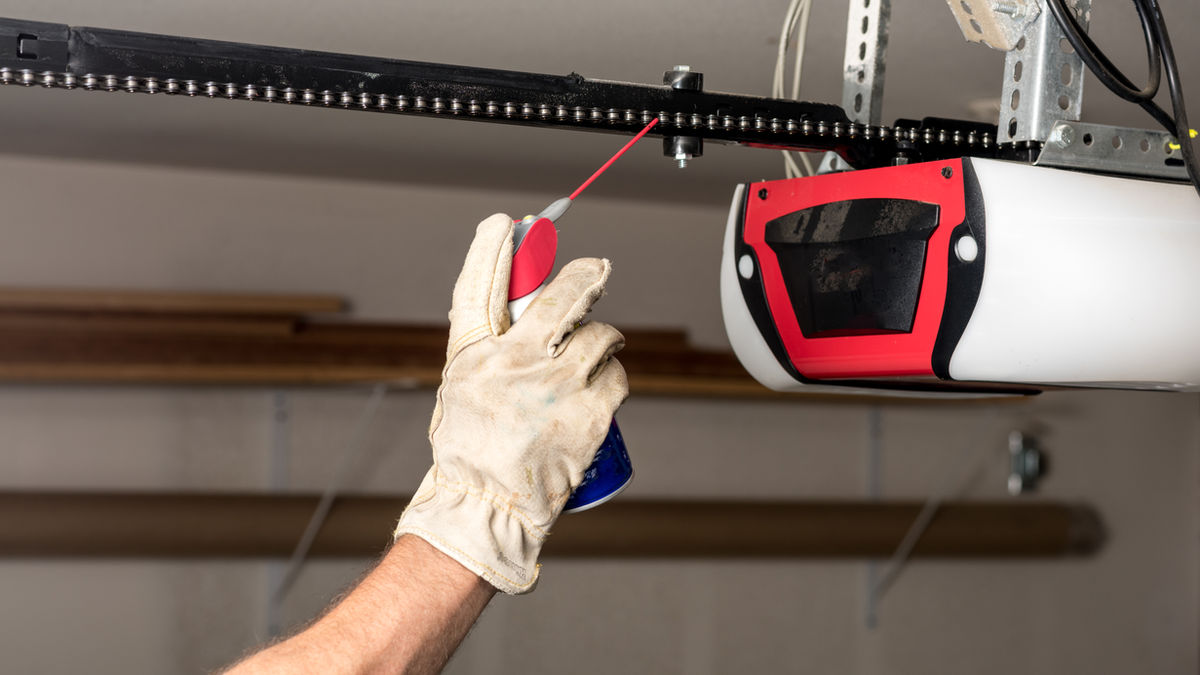
- Lubricate the rollers (the bearings, not the track), hinges and the spring coils with a spray lubricant made for garage doors. IDA recommends lubricating hinges, rollers and tracks about twice a year. DASMA notes that squeaky springs are common and that a garage-door spray lubricant is the first thing to try.
- Check wood doors for peeling paint, swollen edges or panels rubbing against the frame. Wood needs more upkeep than steel in a humid climate.
- Keep the photo-eye lenses clean. Dust, pollen and spider webs build up in summer and can trigger reversals that are not real.
Avoid general-purpose penetrating oils on tracks and rollers. Our maintenance hub page explains that household solvent sprays strip factory grease and leave a residue that attracts grit.
In a humid Kentucky summer, the right garage-door lubricant on the right parts prevents more problems than any other single task.
What belongs on the fall checklist?
The fall checklist is about preparing for cold and dealing with leaves. October and November bring wide day-to-night temperature swings, which change how the door's metal parts fit together.
- Sweep leaves and debris away from the photo-eyes and the threshold. Our post on how fallen leaves interfere with safety sensors explains why a single leaf can make a door reverse.
- Replace a worn bottom seal or perimeter weatherstripping before the first frost.
- Run the reversal test again after the first cold snap. Contracting metal and stiff grease can change how the door behaves.
- Book the annual professional inspection now if it is due, so balance and spring condition are checked before winter's coldest mornings.
Fall is the best time for the annual professional inspection because cold weather is when a weak spring is most likely to fail.
How do you prepare a garage door for a Kentucky winter?
To prepare a garage door for winter, keep the bottom seal from freezing to the floor, keep the threshold clear of ice and snow, and avoid forcing a door that is stuck. Freeze–thaw weather is the defining winter condition in Central Kentucky.
- Clear slush and water away from the door's landing area so the seal does not freeze to the slab overnight.
- If the door is frozen to the floor, do not keep pressing the opener button. Repeated attempts strain the opener and can damage the bottom seal or the door section.
- Listen for new popping or grinding on cold mornings. These noises often point to stiff rollers or hinges that need attention.
- Keep the manual release and a working wall button accessible in case of a power outage.
A frozen garage door should never be forced with the opener; repeated attempts are how a minor freeze becomes a repair.
Which parts should homeowners never adjust?
Homeowners should never adjust, loosen or remove torsion springs, extension springs, lifting cables or bottom brackets. DASMA describes springs as the most important and most dangerous part of a garage door, and it says the bottom brackets are under extreme tension because they connect to the springs.
Spring work, cable replacement and bracket adjustments belong to a trained technician with the right tools. That includes "just tightening" a cable or adding a quarter turn to a spring. If your door has extension springs, DASMA recommends a safety cable running through each spring. If yours has none, ask a technician to inspect it. For background, see our post on the hidden danger of replacing your own extension springs.
Anything connected to the springs, including the cables and bottom brackets, is technician-only work, no matter how small the adjustment looks.
When does a checklist finding mean it's time for a technician?
A checklist finding needs a technician when the door fails the reversal or photo-eye test after you clean and realign the sensors, fails the balance check, has a frayed cable or gapped spring, or makes new grinding or popping noises. The CPSC says an unbalanced door, or one that binds or sticks, should be serviced by a professional.
Some findings point to a tune-up: noise, sluggish travel and hinges that need tightening. Others raise a bigger question. Rusted-through panels, repeated breakdowns or a door that no longer tracks straight after an impact can mean the door is near the end of its service life. If that is where your checklist is pointing, weigh the options carefully before spending on another fix.
A failed safety test is a stop-using-the-opener finding, not something to put on next month's list.
Frequently asked questions
How often should I do garage door maintenance?
Do safety and visual checks monthly, lubricate the rollers and hinges about twice a year, and schedule a professional inspection once a year. The CPSC recommends inspecting the door and opener every 30 days, and DASMA recommends monthly safety checks plus an annual professional visit.
What is the best time of year for a garage door tune-up in Kentucky?
Early fall is a practical choice. It comes after a humid summer and before freeze–thaw weather, when weak springs and stiff hardware are most likely to cause trouble. Any time of year is better than skipping the annual inspection.
Should I lubricate garage door tracks?
No. Clean the tracks with a dry cloth and lubricate the rollers' bearings, hinges and spring coils with a spray lubricant made for garage doors. Grease or oil inside the track channel collects grit, which makes the rollers drag.
Is it safe to pull the emergency release cord?
Yes, as long as the door is fully closed. The CPSC's own balance check starts with the door closed before you pull the quick release. Pulling it with the door open can let an unbalanced door or a door with a broken spring fall.
Can I tighten a loose garage door cable myself?
No. Lifting cables connect to the spring system and the bottom brackets, which are under high tension. DASMA says these cables should be replaced only by a trained technician. Note what you see and have the door inspected.
Why does my garage door act up more in winter?
Cold makes metal parts contract and lubricants stiffen, and a bottom seal can freeze to the slab. Together these add friction the opener has to overcome, which can cause reversals or strain. See our blog post on preparing the track for fall temperature swings.
Sources
- U.S. Consumer Product Safety Commission — Non-Reversing Automatic Garage Door Openers Are a Hazard (Pub. 523) — 30-day inspection advice, 2x4 reversal test, balance definition, closed-door quick-release check.
- DASMA — Garage Doors safety tips — monthly checks plus annual professional visit, springs/cables/bottom brackets under tension, extension-spring safety cables, spray lubricant for springs.
- International Door Association — Safety & Maintenance — monthly visual, balance, reverse and photo-eye tests; semi-annual lubrication.
- DASMA — Paper Towels vs. 2x4s — reversal test with a 2x4 laid flat, performed monthly.
Need a technician?
Springs, cables and off-track doors are jobs for a trained technician. We diagnose the door and explain your options.
859-239-9090 Request serviceLet's get you moving again.
Call us, email us, or request your free quote online. After-hours emergency service is available.